Projects
A collection of projects I've built, exploring the intersection of technology, strategy, and innovation.
AIGIS: Open-Source AI Governance CLI
6,000+ downloads on npm and PyPI, endorsed by a former Washington Post CTO. An open-source command-line tool that compiles a natural-language project description into a deterministic AI governance brief, mapping it against NIST AI RMF, OWASP Top 10 for LLMs, and ISO/IEC 42001 with byte-identical output and overclaim detection. Built on Agent-Computer Interface research: governance content structured for AI coding agents first, humans second.
Anticipate: Predictive Urban Safety System (NVIDIA Spark Hack NYC 2026)
~1.1s end-to-end video-to-risk-score latency, fully on-device: no video ever leaves the machine. Predictive anomaly detection built in 24 hours on an NVIDIA DGX Spark (GB10 Grace Blackwell) using Meta's V-JEPA 2 as a frozen encoder with a custom attentive probe head (4.86M params), ingesting live HLS streams from NYC DOT traffic cameras. I owned the ML pipeline and backend engineering: encoder wrapper, probe architecture, training loop, FastAPI + WebSocket orchestration, and stream ingestion. Team repo.
DeepScout: Search-Grounded AI Browser Agent
Frontier-level web reasoning distilled into two locally served 3B models (~6 GB to ~1.7 GB via NVFP4 quantization-aware training). An end-to-end agentic browser agent (one model for query generation, one for evidence reasoning) covering the full LLM lifecycle: teacher distillation, QLoRA fine-tuning, GRPO reinforcement learning with rule-based rewards, and vLLM multi-LoRA GPU serving, wired into a Chrome extension that produces cited answers from live web results.
Veritas RAG: Local-First Retrieval Engine
~2-3 ms P50 retrieval latency and ~230 ms cold start on a ~10k-chunk corpus. A portable, local-first retrieval engine that packages knowledge into a shippable "retrieval artifact" for fast, offline, privacy-preserving search, with no vector database and no server. Includes published failure analysis on semantic queries and a hybrid retrieval roadmap.
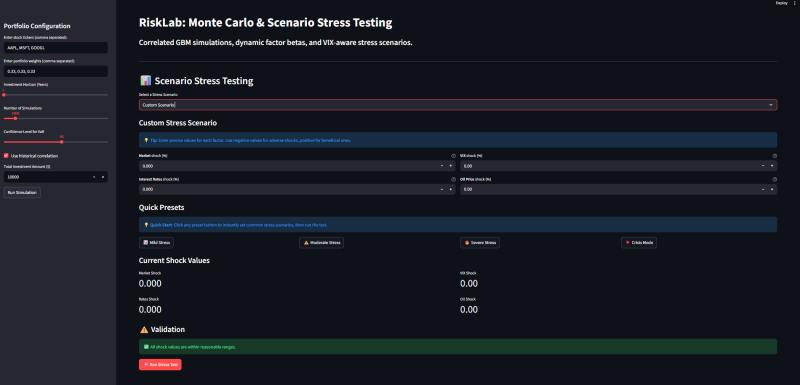
Quantitative-Risk-Simulator-using-Correlated-GBM-Monte-Carlo
Interactive portfolio risk simulator using correlated Geometric Brownian Motion (GBM) and Monte Carlo simulation. Estimates Value at Risk (VaR), Conditional VaR (CVaR), and probability of loss across multi-asset portfolios. Built with Python and Streamlit.
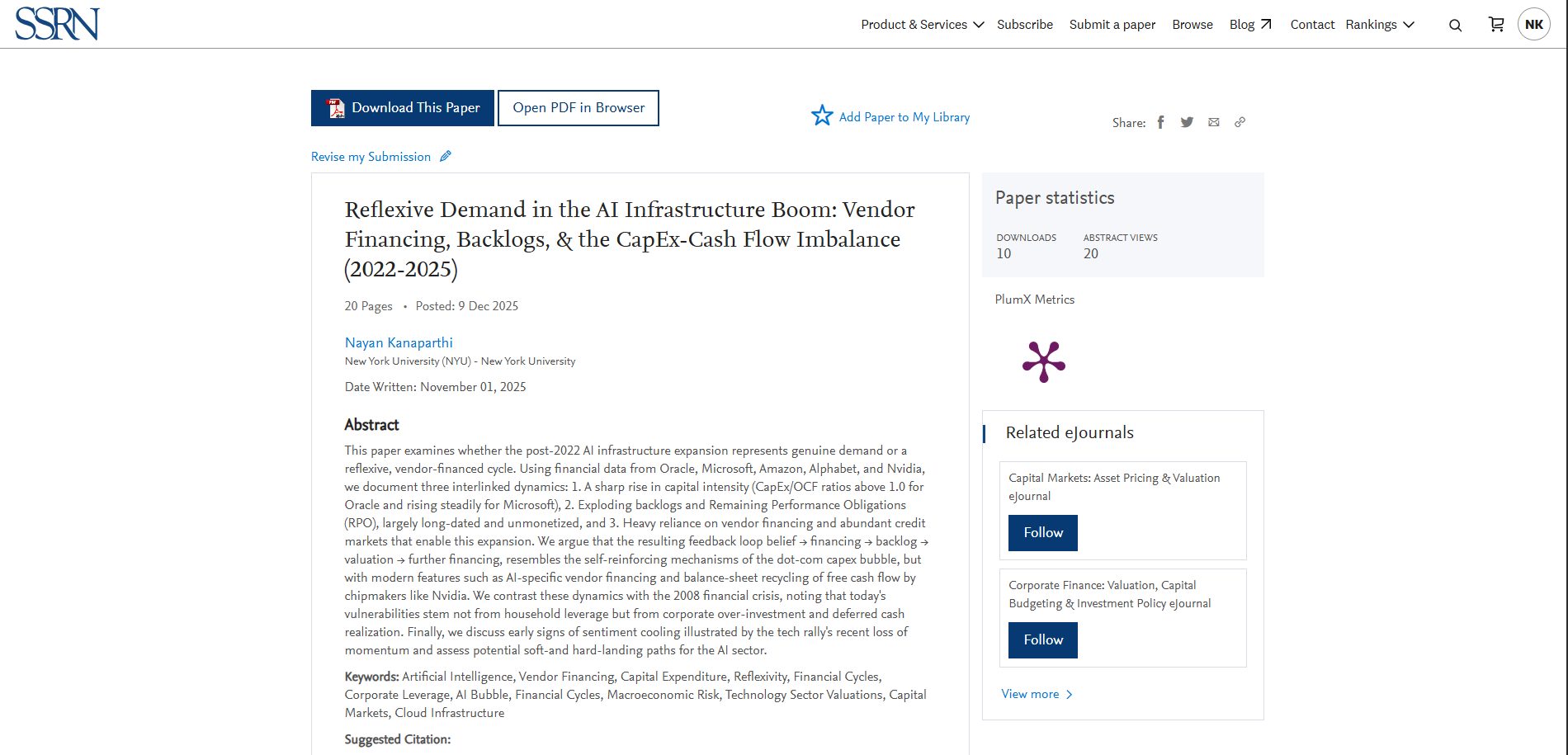
Reflexive Demand in the AI Infrastructure Boom (Abstract ID: 5694302)
SSRN Recent Top Paper, ~1,461 reads. “Reflexive Demand in the AI Infrastructure Boom” analyzes the financial mechanics behind the rapid AI buildout from 2022 to 2025. The paper studies how vendor financing, long-dated backlogs, capital intensity, and credit conditions are shaping the current AI cycle across companies like Nvidia, Oracle, Microsoft, Amazon, and Google. It examines whether today’s surge in AI infrastructure reflects real user demand or a reflexive loop driven by financing structures, incentives, and expectations. The research connects this cycle to past investment booms while highlighting what makes the AI wave structurally different.
StatArb Lab: Statistical-Arbitrage Paper-Trading Rig
A market-neutral statistical-arbitrage research rig: sector-constrained Engle-Granger cointegration pair selection, an Ornstein-Uhlenbeck half-life filter for mean-reversion speed, rolling z-score entry/exit signals, walk-forward replay with strict no-lookahead discipline, and a "loser-autopsy" module that dissects losing trades.
ADHD-Attention LLM: A Mechanistic Interpretability Study
Tested three attention interventions (attention dropout, pre-softmax temperature flattening, and head dropout) on Qwen 2.5 to probe whether loosening attention increases LLM creativity. Delivered a clean negative result with mechanistic failure analysis, written up publicly as "I Tried to Give an LLM ADHD."

The Entrepreneur's Playbook An Interactive Guide to Building a Business That Matters
The Entrepreneur’s Playbook is an interactive guide I created by synthesizing everything I learned during my MIT Bootcamp. It breaks down the full journey of building a meaningful business, from finding your starting point to defining value, validating the problem, developing a business model, and leading your team. Each section distils lessons from MIT’s innovation frameworks into actionable steps, exercises, and tools that help founders think clearly, test ideas fast, and build products that matter.